Artificial intelligence is becoming deeply embedded in both personal and professional environments, from home assistants to AI-powered tools like Microsoft Copilot and ChatGPT. These technologies have become integral to daily routines and workplace operations. Although AI has existed for decades, its influence has grown significantly in recent years. This evolution is also transforming the way organizations approach application development. Businesses across industries are reinventing their application landscapes, placing AI at the center of new app initiatives.
To effectively drive this transformation within an organization, several key considerations must be addressed. Begin by identifying use cases that align with specific business objectives and deliver tangible value. Evaluate when and how to modernize existing applications and data assets to support evolving needs. Also, focus on critical operational priorities and growth opportunities to ensure the organization can scale securely and efficiently as it expands.
AI Investment Strategy
Defining an AI application strategy starts with identifying opportunities within internal processes or customer-facing experiences. This can involve building a complete layer of end-to-end AI-driven interactions. It's essential to approach AI investments strategically, recognizing that ROI goes beyond cost savings. Depending on the business context, ROI can also include increased time efficiency, improved customer satisfaction, and enhanced employee engagement. Key areas to consider for AI investments include optimizing business processes for greater efficiency, enhancing employee experiences, and reimagining customer interactions. Whether accelerating innovation in existing products or developing entirely new ones, the goal is to deliver transformative outcomes for both internal operations and external users. A practical approach is to map AI use cases first to internal objectives and then extend those use cases to external scenarios.
Reinvent Customer Experiences with Intelligent Apps
Personalization and product discovery: Reinventing customer experiences can involve advanced personalization and product discovery. By analyzing customer behavior and preferences, businesses can deliver highly tailored shopping experiences. Integrating semantic search capabilities further refines product discovery.
Content generation and marketing: Develop personalized marketing content across multiple platforms, ranging from social media posts to product descriptions, by leveraging customer data.
Service and support: Deliver personalized and interactive responses to customer inquiries while streamlining routine tasks.
Build your own Copilot: Move beyond traditional chatbots by enabling natural language interactions with enterprise data. This includes generating and summarizing content, extracting insights from large data sets, and delivering more engaging user experiences.
Reshape Business Processes with Intelligent Apps
Build your own Copilot: Reshape business processes with intelligent applications by focusing on improving internal experiences. One approach is to build a custom Copilot that streamlines employee access to information, such as internal policies and documentation.
Transaction processing and anomaly detection: These solutions enable organizations to manage high volumes of transactions quickly, accurately, and reliably. Some businesses have reduced setup times to just a few days, making it faster and easier to implement effective fraud detection mechanisms.
Information discovery and knowledge mining: Transform unstructured data, such as orders, contracts, applications, and forms, into structured, searchable digital information.
Document intelligence and summarization: Automate the extraction, aggregation, and concise summarization of data from diverse sources, including webpages, contact center logs, and internal documents. This streamlines information processing and enhances decision-making efficiency.
Microsoft Azure AI Application Platform
Microsoft's Azure AI Application Platform provides a robust foundation for developing AI-powered applications. It is the same platform that powers Microsoft Copilot, offering advanced capabilities for building, extending, and customizing AI solutions. Whether enhancing Microsoft Copilot, creating a custom Copilot, or embedding AI across business processes, the platform delivers a comprehensive and integrated environment. This enables organizations to build high-performing applications and accelerate their time to market.
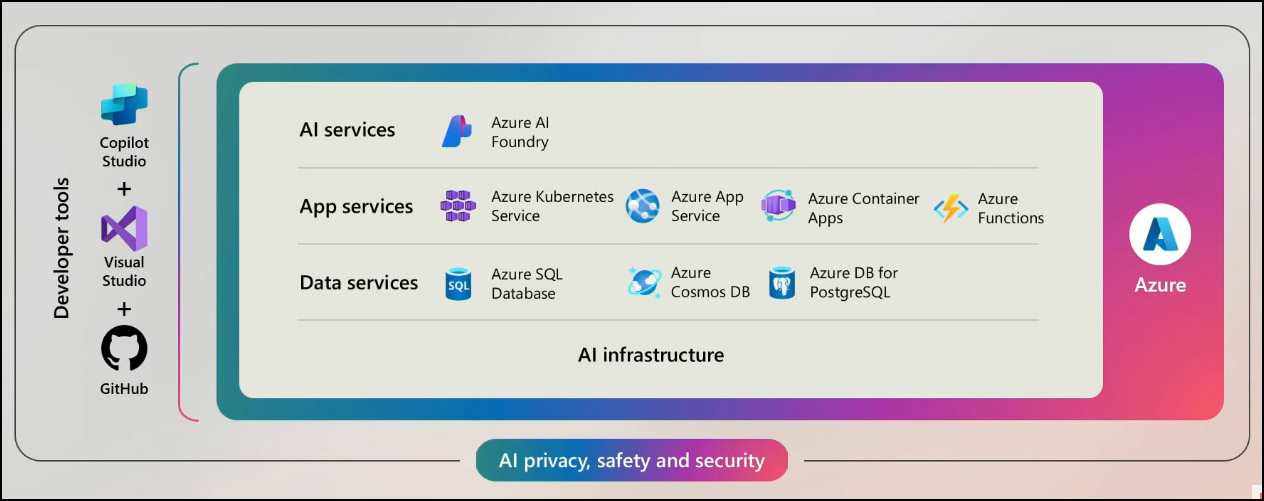
The platform includes a comprehensive AI infrastructure, providing the computing power of CPUs and GPUs, application services for deploying and scaling solutions, and access to foundational models from leading AI innovators. It also integrates business-specific data and provides developer tools for building AI-driven applications. All of this is supported by Microsoft's industry-leading approach to AI privacy, safety, and security.
Azure AI Foundry
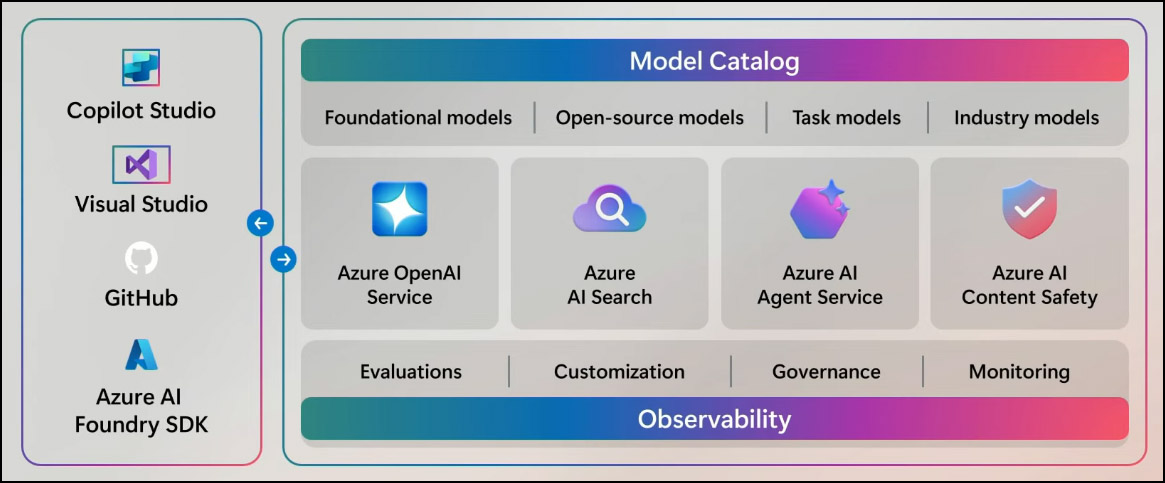
The Azure AI platform is a unified environment that brings together the Azure AI Portal and a consistent SDK experience. It includes prebuilt application templates and access to third-party ISV tools and services. Azure AI Studio is evolving into a fully enterprise-grade management console, providing organizations with comprehensive visibility into cost, quality, performance, and safety. A key addition is the new Azure AI Agent service, designed to connect knowledge, memory, actions, and models, enabling the development of robust and sophisticated applications. This is complemented by services such as the Azure AI Model Catalog, Azure OpenAI Service, and Azure AI Content Safety, all of which collectively power the Azure AI Foundry. Developers can work efficiently by accessing Azure AI services directly from popular development environments, accelerating the journey from concept to code. Microsoft-backed AI app templates, agent orchestration capabilities, and a curated selection of third-party solutions help developers discover the best models available. For IT admins, operations teams, and compliance professionals, the platform offers advanced management and governance tools to deploy and maintain AI applications securely and efficiently.
Key Challenges for Organizations
Each generation of applications has introduced new requirements, and just as web, mobile, and cloud technologies gave rise to modern application platforms, AI is now reshaping how applications are built, run, governed, and optimized. With the rapid advancement of AI models capable of solving complex problems, there is a significant opportunity to automate intricate business processes and human workflows, ultimately driving business growth. Data plays a central role in this transformation. It enables deeper insights, supports data-driven decision-making, and fuels improvements in product design, customer service, and acquisition strategies. For organizations, the opportunity lies in leveraging AI to automate nearly every aspect of operations, from capturing and interpreting business signals to orchestrating workflows and generating actionable outcomes at every step of the process.
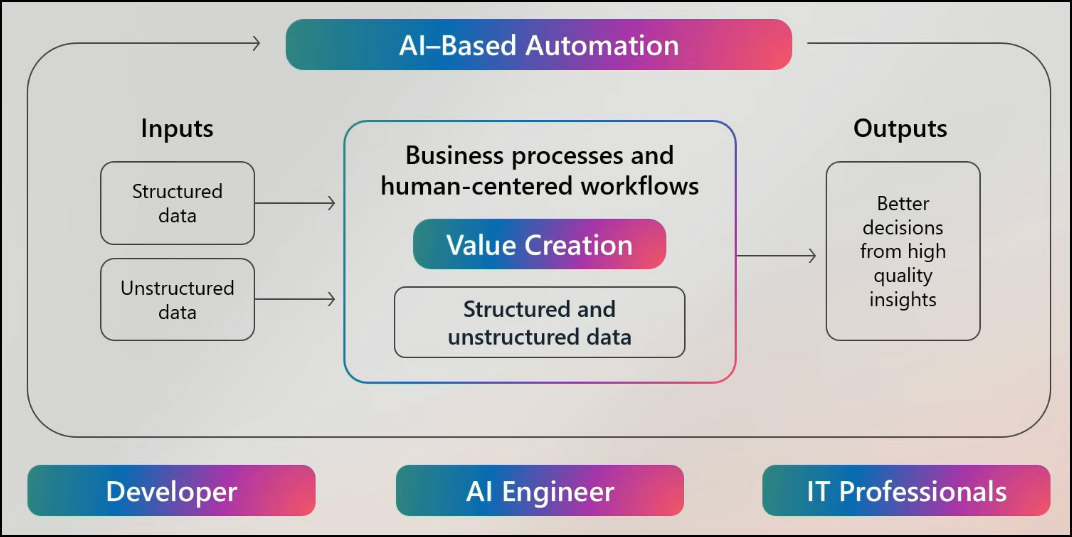
Adopting AI, particularly generative AI, introduces a range of challenges, especially for IT professionals. Developers face a steep learning curve as they adapt from traditional programming models to new tools and rapidly evolving GenAI frameworks, which are frequently updated with new capabilities. AI engineers are tasked with integrating these models into existing systems while navigating legacy infrastructure, often requiring modernization alongside compatibility. At the same time, the role of IT professionals is evolving. They must manage tools that not only meet performance expectations but also address critical concerns around security, privacy, and safety. With generative AI, there's an added emphasis on controlling costs and optimizing resources.
End-to-end Developer Experience for AI App Development
Microsoft takes an end-to-end approach to the developer experience, supporting the entire journey of building cloud and AI applications. It begins within the developer's IDE or code editor, integrating with DevOps tools like GitHub and Azure DevOps, and extends through deployment on the Azure cloud platform. The goal is to enable developers, regardless of programming language, to succeed. To support this, Microsoft provides robust SDKs and libraries for Python, JavaScript, Java, .NET, and Go.
Azure OpenAI SDK
Azure AI SDKs play a central role in enabling the development of AI-powered applications. A key component of this offering is the Azure OpenAI SDKs, available in Python, .NET, JavaScript, Java, and Go. These SDKs bring the advanced capabilities of OpenAI models to the Azure platform.
OpenAI Library for .NET
The OpenAI .NET SDK is a powerful tool that enables .NET developers to access the latest OpenAI features. It integrates with Azure companion SDK libraries, making it simple to transition to Azure OpenAI. This allows developers to take advantage of familiar Azure capabilities such as Azure Identity and other core services.
Azure AI Foundry SDK
The Azure AI Foundry SDK introduces a streamlined developer experience designed to simplify the process of building AI applications. It brings together essential tools for tasks such as model evaluation and tracing, all within a unified framework. One of its standout features is the ability to explore a wide range of models from Azure's expansive model catalog. This flexibility allows developers to experiment, iterate, and integrate AI models more efficiently.
Building an AI App
Through the process of building AI applications and engaging with customers and the developer community, a clear set of steps has emerged for taking an AI-powered application from concept to production. These steps help structure the development journey.
Exploration: In this initial phase, various models are tested in a playground environment. The focus is on experimenting with prompts, gathering examples, and defining what successful output looks like for the application.
Development: This phase involves integrating the LLM functionality into the broader application. Developers begin connecting to existing systems, storing prompts in source control for better versioning, and shaping the user experience. The goal is to build a working proof of concept that starts to resemble the final product.
Evaluations and CI/CD: As the application matures, CI/CD practices become increasingly important. A key consideration is incorporating prompt evaluations into the pipeline, allowing prompt quality to be tested and maintained just like any other automated test in the development workflow.
Pilot: With a functioning application in place, real users begin interacting with it. Gathering feedback becomes critical, and experimentation helps refine the experience. This phase is essential for validating assumptions, improving usability, and preparing for broader deployment.
Production: When building AI applications, it's essential to consider regulatory compliance, such as adhering to GDPR requirements to protect user data. At the same time, cost optimization strategies help manage expenses effectively. To further enhance responsible AI practices, additional safeguards can be implemented.
Reference:
Microsoft Events


