Most IT organizations dedicate roughly 80% of their resources to maintaining and operating existing applications, leaving only 20% for innovation. Now consider the impact of reversing that ratio, allocating 80% of the budget to innovation instead. This shift can accelerate the move from legacy systems to modern production environments.
What is modernization?
Modernization involves evolving both applications and infrastructure to keep pace with technological advancements and shifting customer expectations. At its core, modernization enables faster feature delivery, allowing teams to respond quickly to customer needs and market changes. Most importantly, it supports continuous innovation, not as a one-time effort, but as an ongoing process built on a foundation that ensures systems continue to improve and adapt over time.
Benefits of Modernization
Innovate faster: Modernization streamlines time-consuming tasks, enabling teams to accelerate innovation and shorten their time to value.
Improved security: Legacy systems often contain vulnerabilities that were not a concern when originally built. Modernization introduces advanced security tools and frameworks, making it easier to protect data and maintain compliance with industry standards.
Reduced costs: Updating infrastructure and adopting modern technologies, such as serverless computing and containers, can significantly reduce operational costs. These savings can then be reinvested into growth and innovation initiatives.
Increased developer productivity: With modern tools, developers move beyond slow-release cycles, shifting from weekly deployments to multiple production deployments per day.
Better customer experience: Combined, faster innovation, stronger security, lower costs, and higher developer productivity ultimately deliver improved customer experiences.
Some data support these benefits. A recent TechTarget survey found that organizations undergoing modernization report a 48% faster time to market, nearly halving the time required to deliver new features. Organizations also report a 70% improvement in application performance, which translates to smoother user experiences, fewer bottlenecks, and more cost-efficient, sustainable applications. Most notably, modernization drives a 50% reduction in technical debt, freeing teams from excessive maintenance and enabling them to focus more on delivering business value.
What Defines a Good Modern Application?
One way to address this is by examining the common challenges organizations face and how modernization addresses them.
Slow infrastructure provisioning: In traditional environments, teams often wait days or even weeks for infrastructure to be provisioned, which directly impacts release velocity. Modern tools and services, such as containers and serverless technologies, solve this by enabling on-demand infrastructure, where environments can be ready in minutes. This not only reduces bottlenecks and frustration but also allows applications to scale automatically in response to demand.
Manual deployment: Manual deployments are often slow, error-prone, and make it difficult to release code safely and confidently. Automation is the solution. By adopting modern DevOps practices and implementing CI/CD pipelines, organizations can automate processes from testing to deployment, streamlining their workflows and enhancing efficiency. This not only accelerates delivery but also reduces risk, enabling faster, safer, and more reliable releases.
Ad-hoc security: Many teams struggle to define or implement a clear security posture, often treating security as an afterthought attached late in the process. Modernization addresses this by embedding security into the design, development, and management of applications from the start.
Limited application visibility: Without proper visibility, teams lack insight into application health and performance, leaving them to guess at underlying issues. Instrumentation solves this by collecting logs, metrics, and traces, providing a comprehensive view of how applications run. This visibility enables early detection and resolution of issues before they affect customers.
Inconsistent tooling: When teams rely on their own tools and approaches, it creates fragmentation and inefficiency. Standardizing tooling across the organization fosters consistency, reduces cognitive load for developers, and enables faster and smoother onboarding of new team members.
The Five Pillars of Modern Applications
Successful modernization is not about adopting a single new technology; it requires combining multiple factors, often referred to as the five pillars of modern applications.
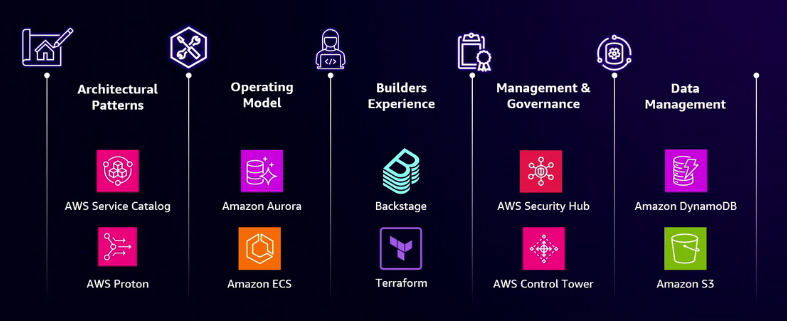
Architectural patterns: Modern applications rely on modular services. By breaking applications into smaller, independent components, teams can develop and scale parts of the system without disrupting the whole. This modularity not only improves agility but also enables the use of the best technology for each component. Common patterns, such as event-driven microservice architectures, can then be defined and made easily accessible to developers through services like AWS Service Catalog and AWS Proton.
Operating model: A strong operating model is essential for reducing complexity, and the objective is to shift as much undifferentiated heavy lifting onto AWS. This is achieved by leveraging AWS Managed Services. For example, migrating relational databases to Amazon Aurora or container workloads to Amazon ECS allows AWS to handle scaling, patching, and availability of the underlying infrastructure.
Builder experience: Providing developers with self-service tools and infrastructure removes bottlenecks, giving them the autonomy to create environments on demand. This not only accelerates the time to start new feature development but also fosters a culture of ownership and productivity. Developer platforms like Backstage support this by standardizing self-service in a centralized location where developers can access repositories, templates, and pipelines. Tools such as Terraform further enhance the builder experience by codifying best practices into reusable modules and automating infrastructure deployment.
Management and governance: Embedding guardrails from the outset ensures that applications remain secure and compliant. Services such as AWS Security Hub and AWS Control Tower provide visibility and enforce best practices without introducing unnecessary complexity into environments.
Data management: Modern applications demand purpose-built data strategies. This may involve using Amazon DynamoDB for scalability, Amazon S3 for data lakes, or flexible data models tailored to specific use cases. The key is selecting the right data store for the job. As generative AI becomes more prevalent, a solid data strategy will be critical to unlocking its future potential.
Challenges of Modernization
Modernization delivers significant value, but it also comes with challenges that organizations must address:
Time and resource constraints: Many organizations fall into the 80/20 trap, where most resources are consumed by maintenance, leaving little room for innovation.
Skills gaps: Modernization depends on cloud-native expertise and modern DevOps practices. Without these skills, progress can slow or even come to a halt.
Budget limitations: The initial investment in modernization may seem overwhelming. But long-term costs of inaction, such as inefficiency, increased maintenance, and lost opportunities, can prove far more expensive.
Technical debt: Legacy systems often carry years of quick fixes and workarounds left behind by previous teams. This accumulated debt makes even small changes risky and time-consuming.
Organizational resistance: Modernization is not only about technology; it also requires rethinking team structures, workflows, and culture. People are a core part of modernization.
These challenges need to be addressed directly to ensure modernization delivers value not only for applications but also for teams and the business overall.
Preparing for Modernization
Modernization can be approached in three key phases. This framework provides clarity, ensures the correct problems are addressed at the right time, and builds a clear path forward.
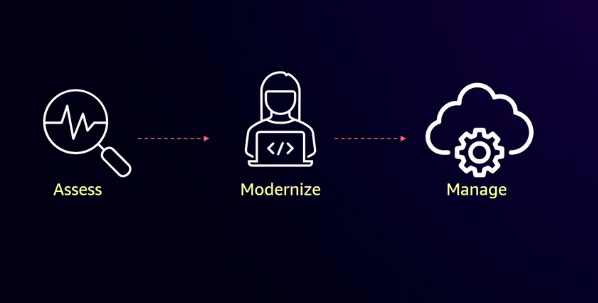
Assess: The process begins with discovery, understanding the current environment, identifying applications in scope, uncovering pain points, and mapping dependencies. With this information, organizations can prioritize which applications to target and determine the best strategy, whether that means replatforming, refactoring, or another approach. The assessment phase lays the foundation for all subsequent work.
Modernize: Insights from the assessment phase are then implemented. This may involve refactoring applications, building APIs, and adopting cloud-native architectures.
Manage: The manage phase ensures ongoing optimization. The AWS Well-Architected Framework is a valuable tool that helps to identify where environments fall short of AWS best practices before modernization. It also continually assesses and benchmarks environments throughout the modernization journey.
Laying the foundations for modernization frequently faces a recurring obstacle that can halt progress at the very start: legacy code. According to a recent survey, 50% of the JetBrains developer community still uses Java 8, a version released nearly a decade ago. This persistence is not due to reluctance to upgrade, but rather to the complexity involved, which highlights why legacy systems often remain in place far longer than desired. This is exactly where automation plays a crucial role, simplifying the time-consuming tasks involved in code migrations. Automation offers a solution by handling the heavy lifting of code migrations, upgrading dependencies, running tests, and refactoring code, tasks that typically consume significant time and energy. Automating these processes enables faster execution, reduces risk, and ensures greater consistency. Its impact is particularly significant with legacy codebases, helping to shift resources away from maintenance toward innovation.
Amazon Q Developer
This advancement is made possible by the rapid acceleration of AI innovation. AI enables automation to go beyond being just a concept or strategy, turning it into fast and practical execution. Tools like Amazon Q Developer exemplify this by quickly analyzing thousands of lines of code and migrating them to modern versions. Amazon Q Developer’s code transformation agent is explicitly designed for code migration. Currently, it can upgrade applications from Java 8 and Java 11 to Java 17. This brings significant cost-saving potential, as applications running on Windows servers can be migrated quickly and then operated on Linux. In addition to version upgrades, Amazon Q Developer improves code quality by incorporating best practices. It doesn’t just update syntax; it enhances overall quality while taking into account the broader context of the project and entire codebase, ensuring the migration produces optimal outcomes.
Reference:
AWS Events


