Businesses today face significant pressure to drive growth, differentiate their products, and improve operating margins. At the same time, many companies understand the potential of technology but struggle with how to implement the latest technological innovations. The current wave of industrial transformation, fueled by AI advancements, is driving a convergence, bringing together people, processes, and places to enable the production of superior products.
People: People are the core of every business. However, as many frontline workers age, companies face challenges in attracting top talent and training them on the latest technological innovations before their workforce retires.
Places: The goal is to create intelligent factories that harness the power of IT and OT data and work together to enhance operations.
Processes: By integrating data from engineering systems, manufacturing, service, supply chain, and other areas, businesses can optimize their processes and create better products.
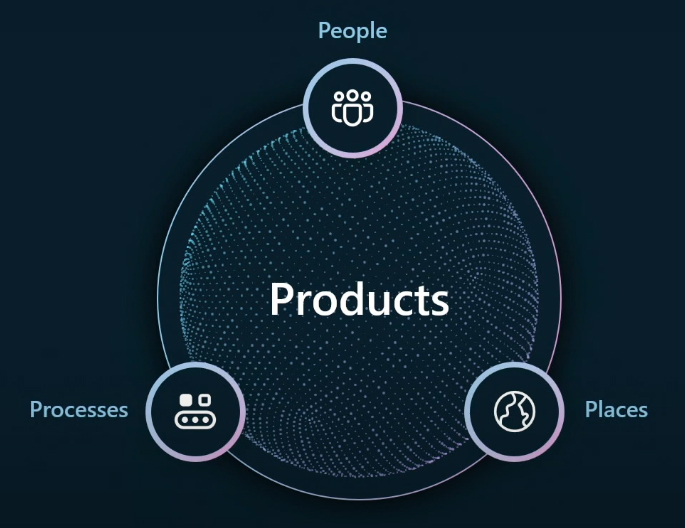
These technologies are not unknown; however, what is transformative is our ability to integrate them, enabling industrial digital transformation and unlocking the next wave of possibilities in the era of AI.
Latest Advancements in Cloud, Edge, and IoT: Building a Strong Industrial Data Foundation
It's inspiring to see how advancements in Cloud and AI enable organizations worldwide to analyze data in ways never before possible. Businesses must be able to leverage data on a global scale to adapt to this dynamic environment. Industrial transformation can be challenging due to the distinct characteristics of physical operations. Each operational site features a unique combination of equipment, technology, processes, and use cases. Organizations often manage numerous such sites across diverse locations worldwide, with employees in various roles, each using different tools, metrics, and KPIs. To drive change, these individuals must collaborate effectively. However, advancements in technology present an opportunity to simplify these complexities.
By adopting a centralized approach to digitizing physical operations, you can eliminate silos, replicate solutions across assets, sites, and locations, and achieve global visibility. A standardized transformation strategy fosters collaboration and accelerates organizational progress. This approach makes it easier for your teams to use data on the shop floor and at the global enterprise level. Leveraging AI globally requires a consistent, scalable foundation with a composable architecture integrating data from diverse sources. It also empowers your teams with low-code and no-code solutions, simplifying the building and deployment of solutions using Cloud-native tools while enabling IT to manage everything consistently.
Azure IoT Operations
Azure IoT Operations expands the Azure IoT portfolio with a modular set of Azure Arc-enabled services designed to simplify the onboarding of assets and devices. This allows organizations to transfer data from physical operations to the Cloud using low-code and no-code tools. Applications can be built at the Edge, leveraging this data to foster collaboration among OT, IT, developers, and data professionals, driving insights and informed decision-making.
Azure IoT accelerates the delivery of end-to-end solutions by significantly reducing complexity and time. The Edge offers a flexible set of composable, Kubernetes-based services that integrate with industrial environments using open standards such as OPC UA, OTel, and MQTT. The entire solution works natively with Microsoft Fabric, enabling you to create context-rich data experiences using Power Platform, Digital Twins, and Azure AI. Azure IoT Operations connects Cloud and Edge through bidirectional messaging, allowing insights to drive actions, close feedback loops, and enable automation.
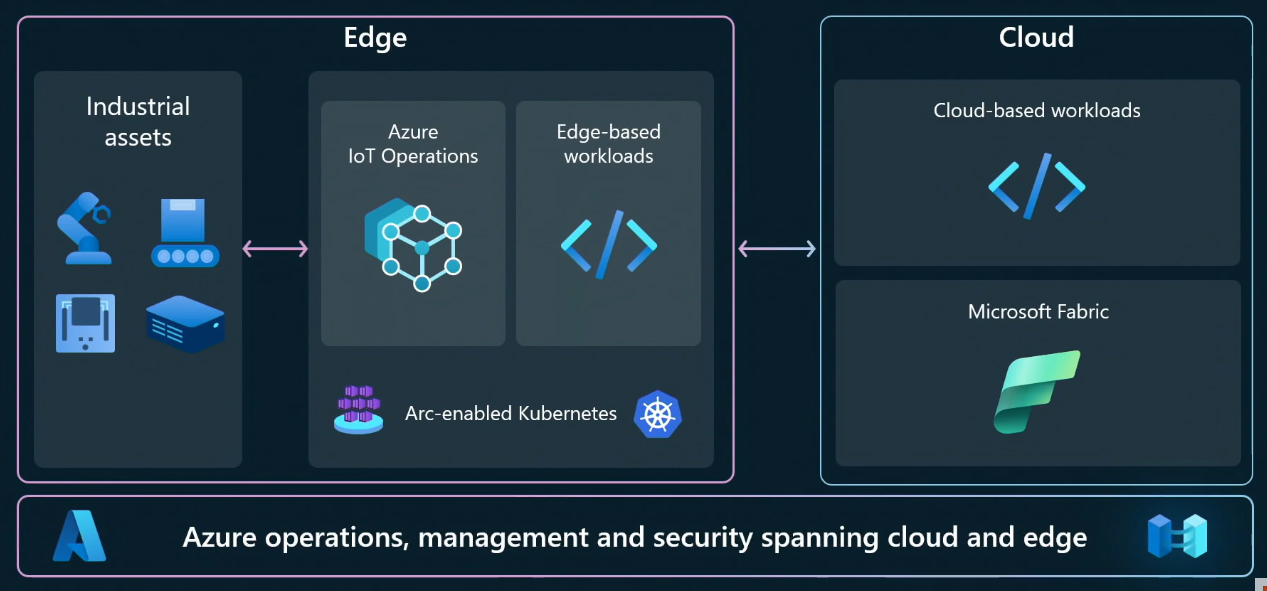
Edge services are managed through Azure Arc, providing enhanced visibility and orchestration for IT while minimizing friction. This approach unifies siloed people, places, and processes, enabling collaboration across various sites, assets, and infrastructure. Azure extends to the Edge with the right capabilities to drive operational outcomes. Edge resources can be managed and secured like any other Azure resource in the Cloud. With the Azure Control Plane, you can achieve repeatability, agility, and automation, scaling your AI initiatives. This strategy empowers your entire workforce to collaborate and solve problems more efficiently.
AI For the Frontline
Frontline workers are the backbone of industries such as field service and manufacturing, possessing deep expertise and specialized skills. Their roles often involve repairing machinery with complex service histories or operating advanced equipment. However, their jobs can be physically and logistically demanding. For example, they may need to consult manuals or customer service records while handling heavy equipment and wearing protective gear, often in challenging environments.
How Frontline Workers Can Use AI in Industrial Settings?
The physical world is becoming increasingly sophisticated, adding complexity to these roles. Both frontline workers and companies report significant challenges in adapting to this shift. A concerning statistic is that only 7% of executives feel adequately prepared to address the growing skills gap expected in the next five years. Projections indicate that over 2.4 million jobs in this sector may remain unfilled due to retirements and a lack of interest in these roles due to insufficient access to modern technology. Recognizing this, 88% of HR managers plan to increase investments in technology over the coming years to address these challenges.
Frontline workflow
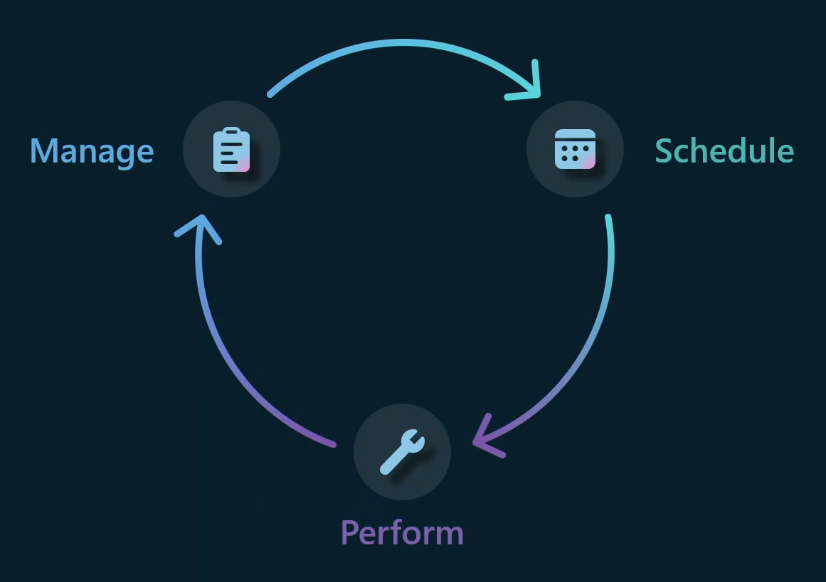
Managers or supervisors typically need an overview of all ongoing work orders for the frontline workforce. They want to see planned tasks and identify any new, urgent repair requests that may arise during the day. Dispatchers and managers must also coordinate people and equipment, considering factors like location, availability, and required skill sets, making scheduling a highly complex task. Frontline workers need tools to perform their tasks, including step-by-step guidance for unfamiliar tasks. They should also be able to easily update records, indicating whether a job is complete or requires additional support. All this information must feed back into the system to make it smarter over time, enabling better insights and workflow optimization as more data is collected.
Dynamics 365 Field Service
Dynamics 365 Field Service addresses these needs by providing an end-to-end solution that supports managers, dispatchers, and frontline workers while improving overall operational efficiency.
Millions of connected assets are monitored in the field service product, and when an IoT signal goes out of range, it can automatically trigger and generate a work order. For example, managers might spend much time communicating with their crew in Teams. Within Teams, they can use Copilot to get an update on work orders that need scheduling. This information is conveniently displayed in the chat, showing all upcoming work orders. If more details are required, the manager can access Dynamics to dive deeper into the specifics of a work order. Inside Dynamics, Copilot can even suggest ready and available technicians to complete the job. This streamlined process allows for faster generation of high-quality work orders and ensures they are assigned efficiently to the right technicians. However, generating and assigning work orders is just one part of the process, and supporting technicians in performing the work remains a critical focus.
Mixed Reality: Mixed Reality is an excellent tool for enhancing technicians' understanding by providing volumetric renderings and visually showing how components fit into their environment. This approach leads to a 24% reduction in onboarding time for new technicians and a 30% improvement in efficiency across all technicians.
Remote Assistance: Using Teams, technicians can view their co-workers' screens through their eyes and annotate directly on their screens, guiding them on what to do. This eliminates the need for travel, whether by plane, train, or automobile, to resolve issues. As a result, companies experience a 45% reduction in training-related travel and a 23% decrease in equipment downtime.
Many companies are currently facing the challenge of a mass retirement of experts, causing valuable workplace knowledge to be lost. To ensure that this expertise is preserved and accessible to everyone, it's essential to capture the understanding of physical processes and embed it into systems. To address this, simple authoring tools are available within Guides. However, scaling this effort across thousands of guides within an organization requires generative AI.
Here's a look at what's happening behind the scenes. You can access these capabilities through D365 Guides and Field Service. The data sources, such as SharePoint and Dataverse, store the information and are fully interoperable with Microsoft Fabric, with support for additional databases expanding over time. Key enabling services include Azure Spatial Maps and Azure OpenAI Service, incorporating advanced vision technology. This enables a contextual understanding of the physical world, providing rich prompts for Copilot.
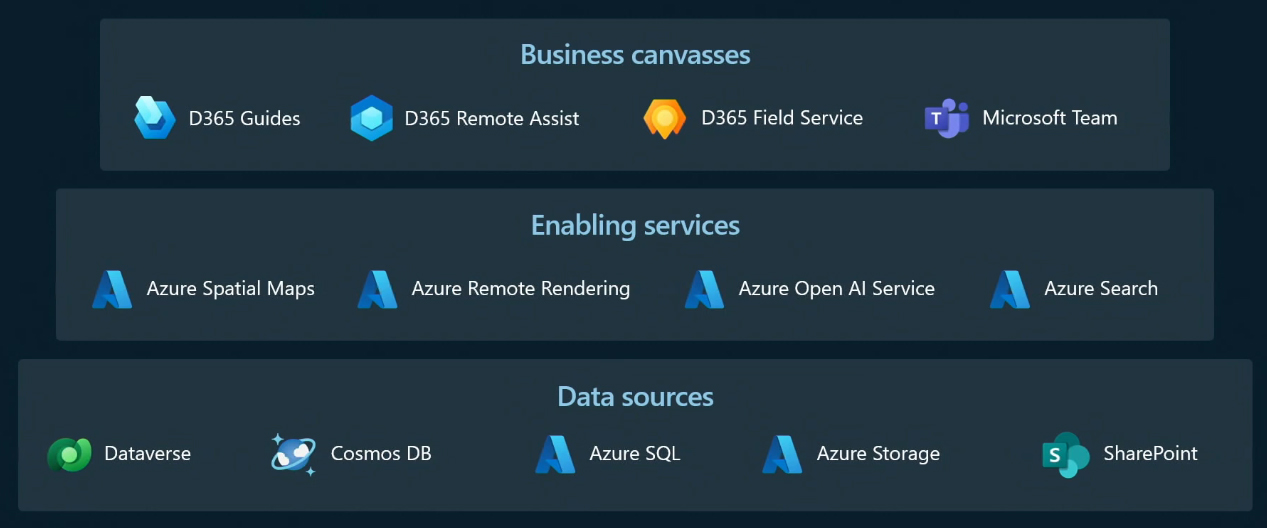
Spatial and Vision technologies work together to enhance the understanding of environments. Spatial excels at interpreting dimensional aspects of complex settings, making it ideal for proprietary equipment or complex machinery, such as examining the layers within a car engine. Vision is particularly effective for general knowledge and publicly available information, focusing on surface-level details. Together, these technologies complement each other, combining dimensional and visual insights to provide a comprehensive and accurate understanding of the context.
Conclusion
The convergence of people, processes, and places is key to designing better products. It begins with establishing a robust industrial data foundation. This involves integrating data from all sources into a unified foundation, whether it resides at the Edge, in the Cloud, or originates from IT or OT systems. With this strong data framework, AI can be leveraged to drive business innovation. Next, this foundation is brought together in the industrial metaverse, where Mixed Reality and Copilots transform the experience for frontline workers.
Reference:
Microsoft Events


